
Most of medicine can measure the organ it treats.
Psychiatry still mostly can't.
Cardiologists have the ECG. Neurologists have imaging. In psychiatry, an assessment still rests almost entirely on what a patient can describe, what an informant remembers and what a clinician observes in a limited appointment. You do that well, but you do it without a physiological measure in the room.
Lyfjaberg is Eir Tech's research programme asking a simple question: can six minutes of resting-state EEG give psychiatrists an objective layer of information to sit alongside the clinical interview?
Why it matters
- Presentations overlap. ADHD, anxiety, autism, mood disorders and trauma can look alike in the room, and frequently co-occur.
- Some patients are hard to see. Women and girls who mask, adults who have built compensations over decades, and patients without an informant.
- Treatment is still trial and error. Choosing and titrating medication often takes several appointments, and side effects drive many people to stop.
- Waiting lists are long. Anything that makes an assessment more confident is worth studying.
What EEG insights is
Eir's main service is the journal note: from the consultation to a record you review and sign. EEG insights is a second, separate service that is still at the research stage. It never touches the clinical record and is never needed to write or sign a note.
EEG insights is Eir's research programme on using EEG in psychiatric assessment. Our automated programme cleans, analyses and summarises a six-minute resting-state recording from a portable headband, so clinicians can use EEG alongside their usual assessment without specialist expertise. It draws on EEG markers already published in the literature. The programme does not diagnose. Our research asks whether these neurophysiological insights can make assessments more accurate and help inform decisions about diagnosis and treatment.
What we're exploring
Quantitative EEG measures how electrical activity is distributed across frequency bands: slow-wave (delta, theta), alpha, beta and gamma. Decades of research suggest these patterns differ between groups of people, but the field has struggled with small samples, inconsistent methods and expensive lab equipment that never reached clinics.
How it would fit into an assessment
-
Six minutes. Eyes closed, then eyes open, at rest, in your clinic.
-
A lightweight portable headband. No gel cap, no EEG lab, no technician.
-
A clear report. Relative band power, individual alpha frequency and signal quality for each channel.
Synthetic -
You interpret it. Measures only, with no label, threshold or classification. The clinical judgement stays yours.
What the research module shows

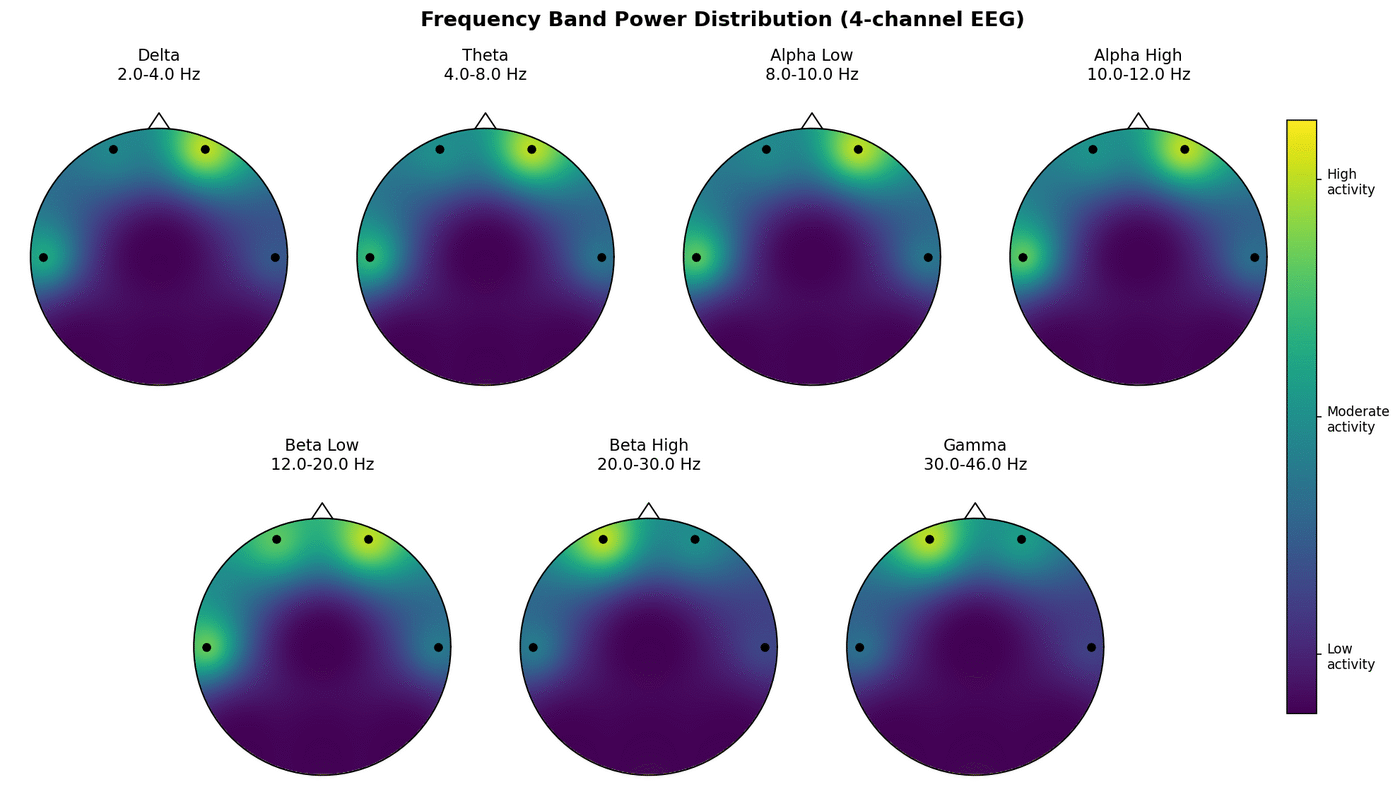
Research only · not a diagnostic tool. The module computes measures from the recording. It is not a validated diagnostic, treatment or emergency alert service.
What's different about this approach
- Deterministic and transparent. A fixed calculation you can inspect, not a black-box AI score.
- Built for real clinics. Portable, quick and affordable, so it can be studied where assessments actually happen.
- Led by a clinician-neuroscientist. Designed by Dr Monica Berntsen, psychologist with a PhD in neuroscience, from her own assessment practice.
- Separate from your records. The research module is kept apart from Eir's documentation workspace and is never needed to use it.
What we're looking for
Psychiatrists and psychologists who run adult ADHD or neurodevelopmental assessments and want to help shape this. Clinical partners can:
- See the report and workflow before anyone else and tell us what would actually be useful.
- Help design the Phase 2 protocol and outcome measures.
- Be involved in publications that come out of the programme.
- Take part without any obligation to use Eir's documentation product.
Phase 1 and Phase 2
Phase 1 gathers feedback from psychiatrists and psychologists who try EEG insights in their own clinics: how a short resting recording fits their workflow, the signal quality, and how clear the report is. It is not a clinical study and makes no claim about diagnostic performance. Phase 2, a later clinical study, would only start with research ethics approval.
Research is a separate choice
The research module is separately permissioned, separately labelled and never required to create or sign a note. Eir does not submit your notes or audio to research. Participation is by agreement and is never a condition of any plan.
Opt-in contributions
Clinicians can propose a limited aggregate contribution for internal review once they have at least twenty signed consultations. The proposal contains only a rounded count of signed consultations: no notes, audio, identifiers or EEG. Removing direct identifiers does not by itself establish anonymity, so any wider research dataset requires a reviewed protocol, a lawful basis, a disclosure-risk assessment and approval before release.
Work with us
If you run adult ADHD assessments and want to help shape the Phase 1 workflow, or you have a research protocol or an evaluation partnership in mind, we would like to speak with you.
Reach a signed, exported note on a synthetic case in your first ten minutes.
Start with a synthetic consultation today. Real-patient use begins only after your clinic's data agreement, configuration and access checks are complete.